Selected work
Research & Projects
Questions from linguistics and cognitive science, turned into controlled experiments on language models: how moral framing changes a model’s dilemma choices, which properties change when a noun is modified, and, on the human side, how children come to tell possibility from necessity. Writing samples, course projects and earlier studies with people sit alongside them.
Research
Questions from linguistics and cognitive science: the human evidence they start from, and controlled experiments on language models, behaviour first, then inside the model.
Mechanistic interpretability
Moral framing and dilemma choices in language models
When moral wording changes a model’s choice, what changes: the weighing of outcomes, a tendency to answer with action, or some other process? And how far can internal interventions tell these apart?
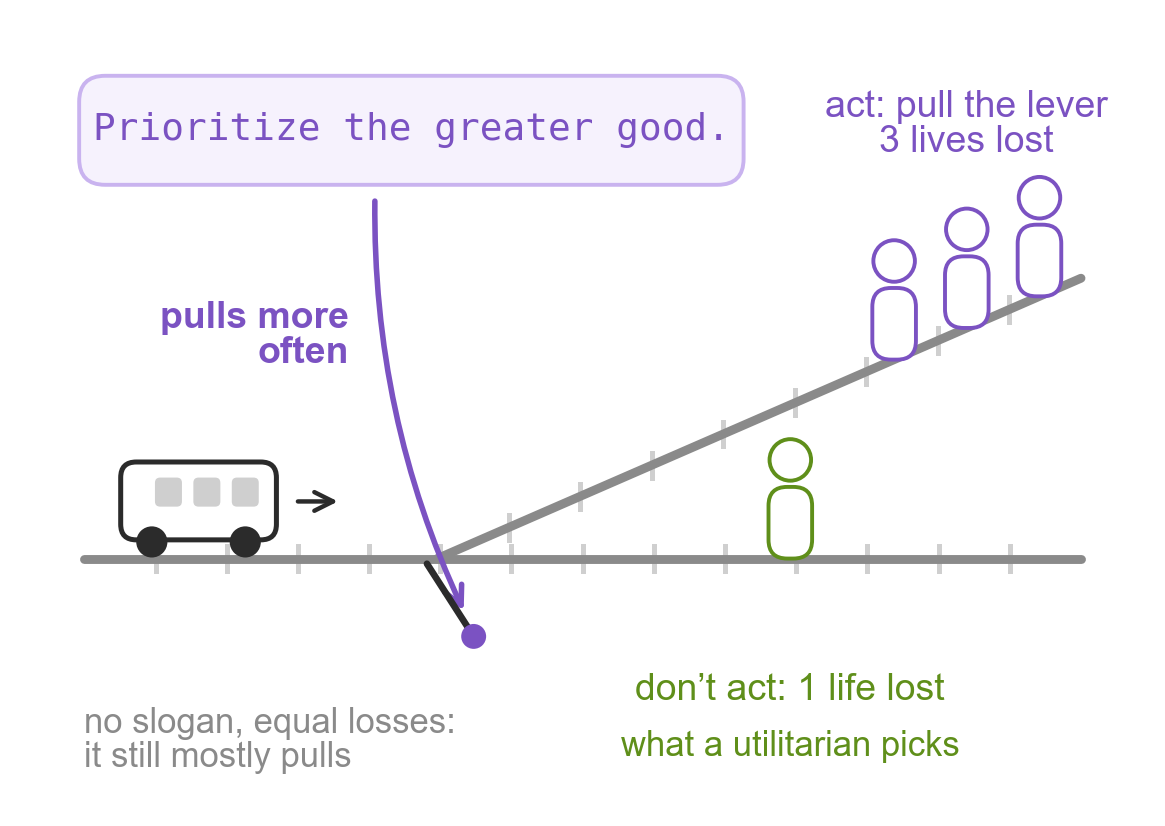
Behaviour and interpretability
Which properties change when a noun is modified?
When a modifier adds a feature, as in a winged dog, which property answers shift in language models: those that depend on it, those that merely co-occur with it, or those associated with the word?
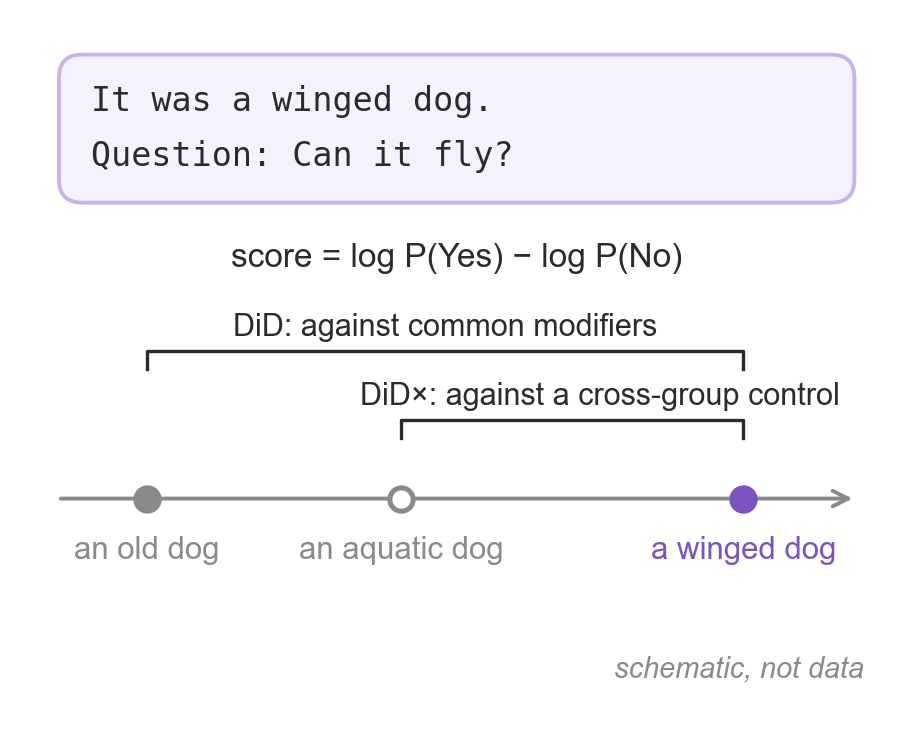
Vagueness · controlled training
Can vague words teach a scale?
Speakers disagree about where tall ends. For a learner that sees only text, is that disagreement noise, or evidence about the scale underneath?
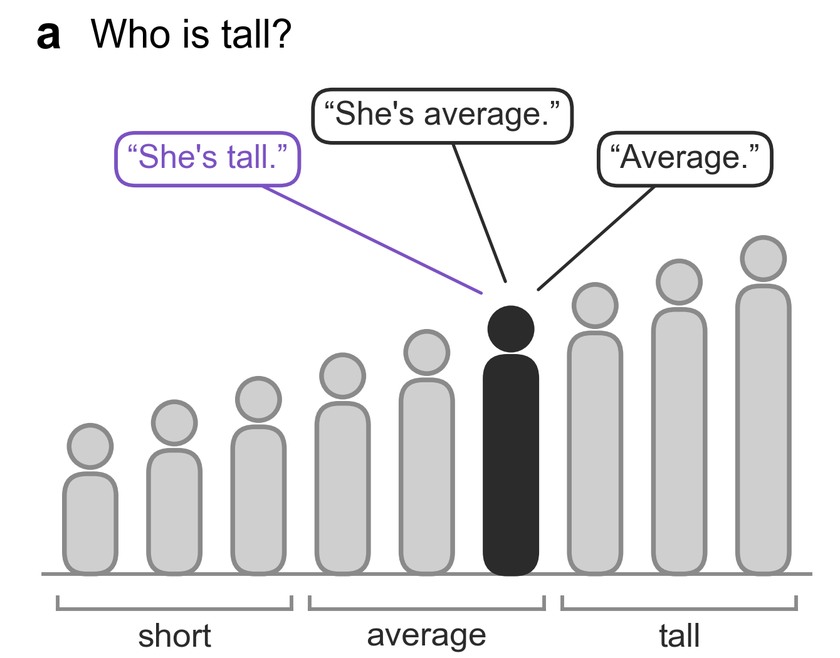
Modality · human side
Modal language in preschool children
How do preschool children come to tell possibility from necessity? The study lays the groundwork for later work on modal language in language models.
Writing
Analyses written up on their own; used as writing samples.
Typicality
Typicality in referent choice: what the description leaves open
Separates three conditions under which a description meets two candidates that differ in typicality, and what a forced choice between them can and cannot show.
Modality
Three Ways of Leaving p Unsettled
Compares answers that leave a question open, such as might p and I don’t know whether p, by the replies and continuations each one licenses.
Course projects
Model training · image CNN
Training choices in a small CNN for street-view country classification
Training choices alone took a fixed 1.69M-parameter network from 0.62 to 0.82 validation accuracy; the best dropout rate depended on training length.
EEG experiment
A group EEG study in Cognitive Neuroscience
A guided group study covering preregistration, EEG recording, and preprocessing and analysis in MNE-Python.
Earlier research experience
A course evaluation of vision–language models, a master’s course experiment with people, and an undergraduate reading assessment.
Model evaluation
Cross-lingual prototypicality bias in multimodal evaluation metrics and VLM judges
With each image pair held fixed and only the prompt language changed, both VLM judges changed their answer on about 70% of items in at least one of seven languages.

Behavioural experiment
Taking a language model’s word for it?
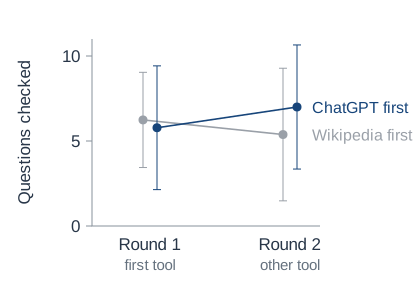
Participants answered ten general-knowledge questions and could check each answer, first with ChatGPT or Wikipedia (assigned at random), then with the other source. Starting with ChatGPT did not reduce double-checking (N = 47). Designed in a group of three and run by the whole class; I did the analysis and wrote the report and poster.
Child reading assessment
Reading difficulties in primary-school children
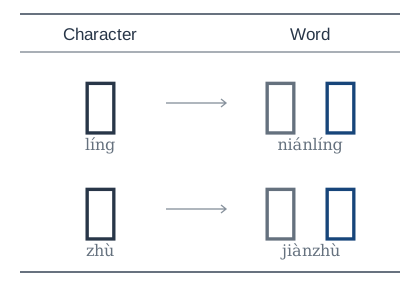
How does presenting a Chinese character alone or within a word change access to its pronunciation? A project report on reading assessment, with qualitative observations and character–word examples.
For the questions connecting these projects, see my research program.