Which properties change when a noun is modified?
When a modifier adds a feature to a noun, as in a winged dog, which property answers shift in language models: those that depend on the feature, those that merely co-occur with it, or those associated with the word?
A controlled study of modifier–noun phrases in three instruction-tuned language models, comparing three accounts with item-level predictors fixed outside the models.
Three accounts
A modified noun rarely keeps all the properties of its head: a wooden spoon keeps the function of a spoon but not its metal look. Telling someone that a dog has wings sets one feature. On a causal-model view of concepts, properties the feature causes or enables (it can fly) should follow, while properties that are only typical of winged things (it has a beak) should not. On a category-based view, the modifier is evidence about what kind of thing is described, so bird properties rise together. On an associative view, the word winged simply primes related words.
Each account gets an item-level predictor that does not come from the models: a dependency table written from theory and fixed before testing, feature co-occurrence in human property norms, and word-association strength in human association norms. On these items the three predictors come apart, so they can be compared within one analysis.
Materials and controls
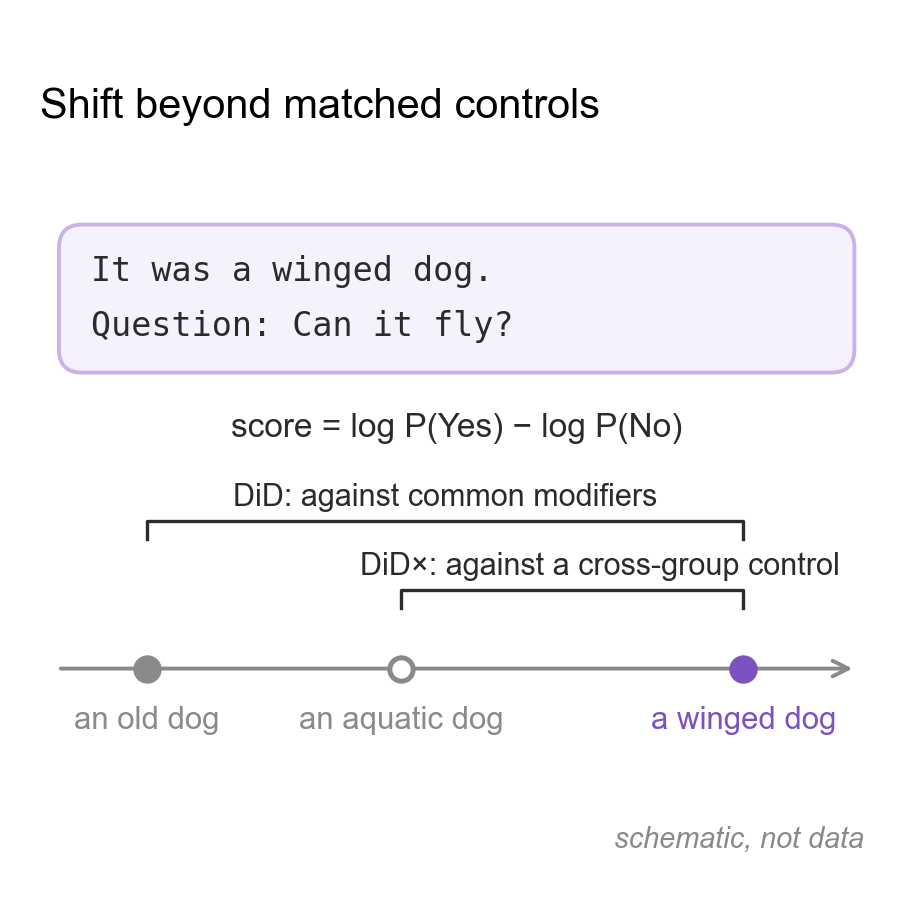
Thirteen feature groups (winged, glass, motorized, …) are applied to nouns that lack the feature. For each phrase the model is asked about dependent properties, co-occurring properties and the noun’s own characteristic property. Every item is also asked about the bare noun, about the noun with common modifiers (old, nearby), and about the noun with a feature from another group, which is just as unusual but unrelated to the property in question. A separate set removes features (wingless).
Models and measures
Three instruction-tuned models answer yes/no questions; the score is the log-odds of Yes over No at the first answer token, checked under two further phrasings. Before any modifier effect is read, bare-noun scores must agree with human norms. Confidence intervals resample feature groups, so the dependency relations, not the phrases, are the unit of generalization. The success criteria were fixed before the runs.
Inside the model
An exploratory activation-patching analysis on pilot materials copies the residual stream at the modifier or noun position into a matched phrase, one layer at a time, to see where the shift arises. It is a first look, not yet a full analysis.
Status
Manuscript in preparation.