Project report · undergraduate reading assessment
Character Reading in Isolation and Word Context: A Report on Childhood Reading Assessment
Undergraduate project · Shenzhen University (2021)
Project period: September–December 2021
Abstract
This project concerns the assessment of reading difficulties in primary-school children. Participation included preparing Chinese-character materials, on-site testing, analysis of response data, and assistance with teaching items and individual learning plans. Reading tasks involved character and word pronunciation, with timing and accuracy records. An observation during assessment raised a question about word context: a child’s word reading revealed more character knowledge than anticipated from single-character reading. This report describes the project’s tasks, illustrates the contrast with character–word examples, and discusses possible explanations for context-dependent access to pronunciation.
Keywords: Chinese character reading; childhood reading assessment; word context; pronunciation retrieval
1 Project and research question
The project was undertaken with the Shenzhen Learning Disorders Association and Yucai No. 2 Primary School from September to December 2021, following an invitation from Dong Li at Shenzhen University. Its practical focus was assessing children’s learning difficulties and supporting appropriate teaching materials and individual learning plans.
A question arising from the reading assessments was how a written character’s presentation context contributes to access to its pronunciation. An isolated character and a word containing that character offer different information. Comparing the responses they elicit can help identify questions about recognition, familiarity and retrieval.
2 Tasks and participation
I helped select Chinese characters and prepare PowerPoint slides with one character on each slide. The project involved timed reading tasks and accuracy records. Children were assessed in batches, and I took turns participating in on-site testing and analysing the collected response data. Participation also included online observation of assessments and assistance with teaching items and individual learning plans.
The assessment activities included single-character pronunciation, word pronunciation, visual discrimination and pattern tasks. Character-reading accuracy and reading time provide complementary descriptions of performance. Wong et al. (2021), for example, distinguish character-reading accuracy from performance under time pressure; these distinctions are useful when interpreting a reading assessment.
| Component | Activity | Purpose |
|---|---|---|
| Materials | Chinese characters presented individually on slides | Support character-reading assessment |
| Testing | Batch assessment; character and word pronunciation | Collect reading responses |
| Data analysis | Work with timing and accuracy records | Describe performance and support educational planning |
| Teaching support | Teaching items and individual learning plans | Connect assessment with educational support |
3 An observation from the assessment
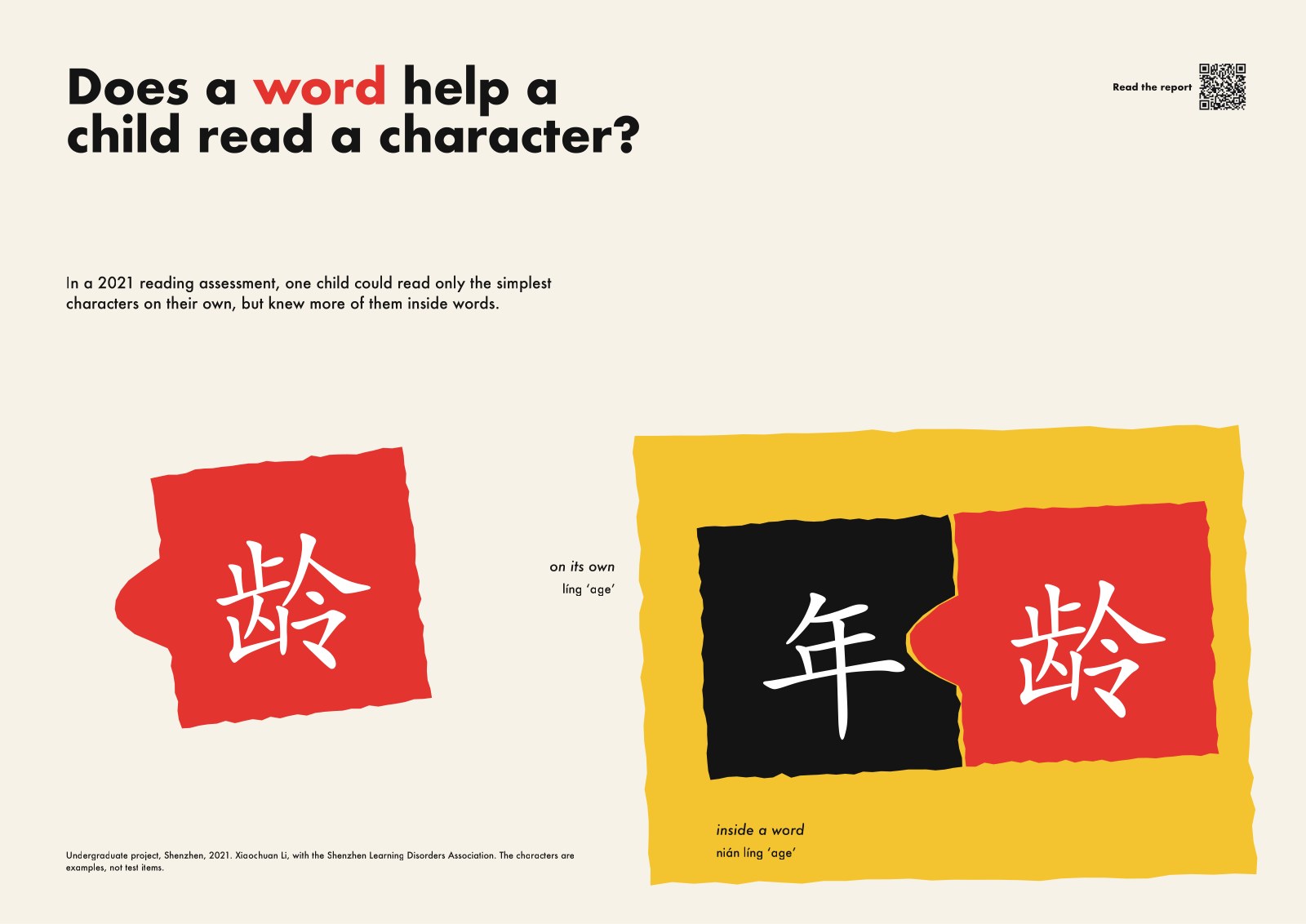
During an online assessment observed with two teachers, a child initially pronounced relatively simple, common characters in isolation. When words were subsequently presented, the child’s responses revealed more character knowledge than anticipated from the earlier single-character performance. The observation was recorded in a reflection on the assessment (Li, 2021).
The child also appeared to perform well on visual discrimination and pattern tasks. These observations prompted questions about how familiarity, task context and connections between written form and sound contribute to reading performance.
4 Character reading in isolation and word context
The following illustrative examples show the contrast between an isolated target character and the same character within a word.
| Isolated character | Within a word | Pronunciation and meaning |
|---|---|---|
| 龄 líng | 年龄 niánlíng | 龄: age 年龄: age |
| 筑 zhù | 建筑 jiànzhù | 筑: build 建筑: building; architecture |
In each pair, the target’s written form and intended pronunciation remain the same. Word presentation adds another character and a lexical context. The question is whether that context can support pronunciation retrieval when an isolated character is difficult to read. A word’s familiarity would need to be established for the children taking part.
5 Discussion
Several accounts could explain apparently stronger word reading. Familiar word context might act as a retrieval cue, or a child might recognise a word as a whole without independently recognising each character. Differences between the items, attention or task understanding could also contribute. These explanations concern distinct processes and would require controlled comparisons to separate.
A suitable comparison would use the same target characters in isolated and word presentations, establish word familiarity, and control presentation order. Reading accuracy would describe successful pronunciation, while a clearly defined timing measure would provide information about reading efficiency.
This report presents project activities and qualitative observations. The observation was not a matched-item experiment, and the illustrative examples are not response data. It motivates a question about context and pronunciation without estimating the size of a context effect.
References
Li, X. (2021, September 13). 儿童阅读能力测评观摩感想 [Reflection on observing a childhood reading assessment]. Unpublished project reflection.
Wong, Y. K., Tong, C. K.-Y., Lui, M., & Wong, A. C.-N. (2021). Perceptual expertise with Chinese characters predicts Chinese reading performance among Hong Kong Chinese children with developmental dyslexia. PLOS ONE, 16(1), e0243440. doi:10.1371/journal.pone.0243440.