Can vague words teach a scale?
Speakers draw the boundaries of words such as tall or green in slightly different places. For a learner that sees only text, is this disagreement noise, or evidence about the scale underneath?
A theoretical and computational study of vagueness: what speakers’ disagreement about word boundaries costs a listener and what it tells a learner, tested with language models trained only on naming text.
The idea
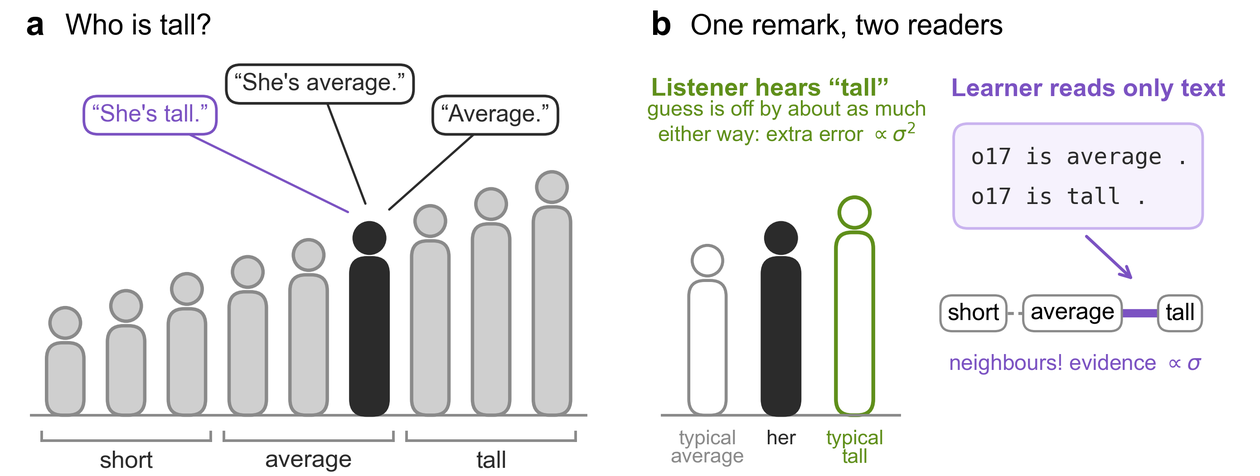
Lipman (2025) showed that when speaker and listener share a goal, vagueness cannot do better than precision. That result is about communication. This project adds a learner who sees only text. For such a learner, the misdescriptions that vagueness produces are informative: an object that some speakers call tall and others call average shows that the two categories are neighbours. Near agreement, such a misdescription costs the listener little, because the object lies close to a boundary, yet it tells the learner something about the order of the categories.
A short proposition states when an objective that gives weight to this learner is not maximised by a perfectly precise vocabulary. It does not overturn the result on communication alone.
Predictions
Four predictions follow: without disagreement, no order among the categories can be recovered from text; a little disagreement is enough; the direction of disagreement carries the order; and aggregating speakers by majority vote erases it.
Learners and data
The learners are language models trained only on naming text, from small transformers and LSTMs trained from scratch to a fine-tuned pretrained model. The tests use an artificial language with a known underlying scale, and the colour naming of individual speakers in the World Color Survey. Success criteria were fixed before the confirmatory runs, and each confirmed result was re-implemented independently from the written specification.
Status
Preprint, October 2026: Li, X. (2026). What Can Be Learned from Vagueness. Zenodo. doi:10.5281/zenodo.23677586 (CC BY 4.0).